



Perception and hallucinations
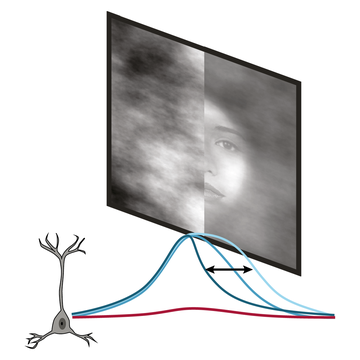
What reaches our eyes and ears does not become an experience instantly. We test whether the brain builds it up by gathering evidence over time, much as it does when making a decision, and whether hallucinations arise when that process leans too heavily on what we expect. We also ask what changes when consciousness fades under anesthesia.
Metacognition and doubt
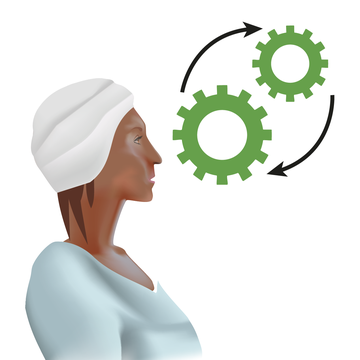
Metacognition is our ability to judge our own decisions. Doubt is useful when it tracks how likely we are to be wrong. In obsessive-compulsive disorder, it seems to come loose from that. We study what the brain is monitoring, and what it does with the answer.
Intracranial recordings
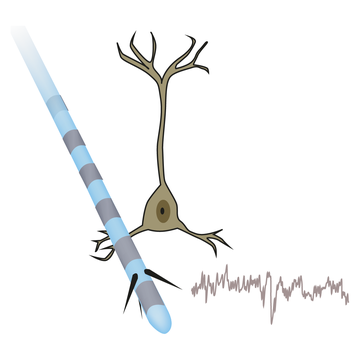
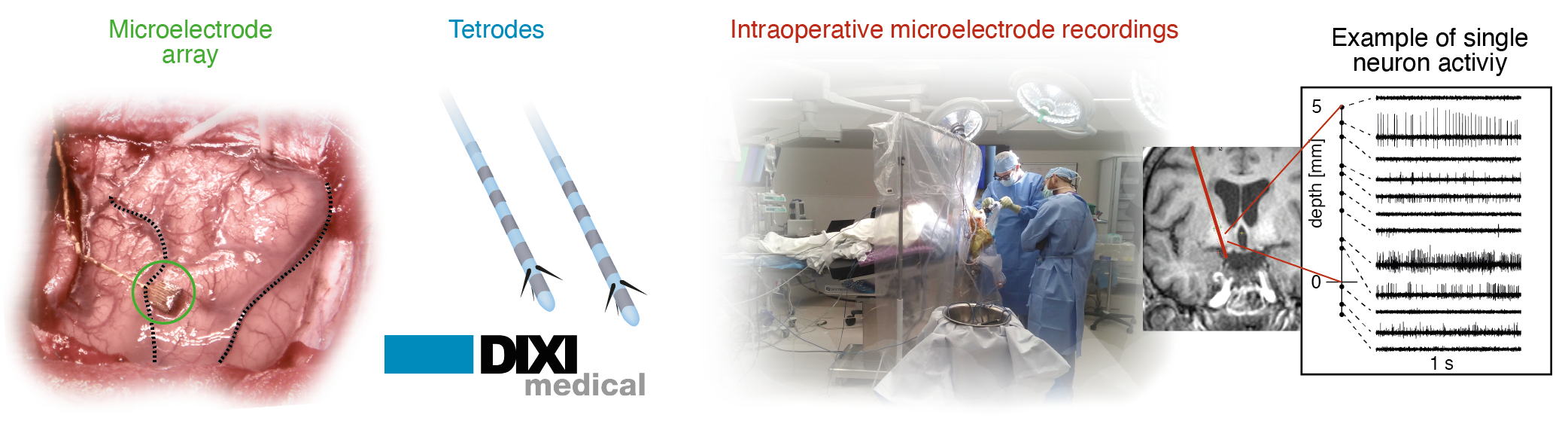
Some people with epilepsy have electrodes placed inside their brain for a few days so that doctors can locate their seizures. With their consent, we record from these electrodes, and sometimes from finer wires that pick up single neurons. These rare recordings let us separate an experience from the decision to report it.
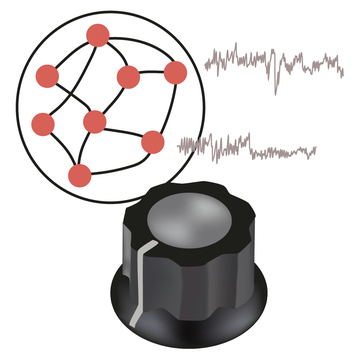
Computational modeling
We turn our ideas into mathematical models and simulated networks of neurons. A model has to make predictions precise enough to be checked against what people report and what their neurons do.
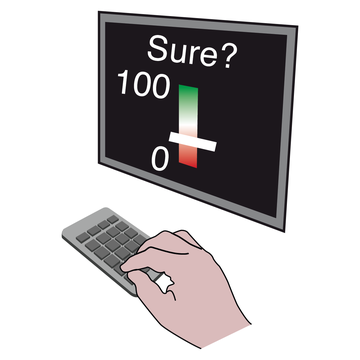
Psychophysics
Subjective states are private and cannot be measured directly. Psychophysics is the design of experiments that make them measurable: whether something was seen, how long it seemed to last, and how intense it felt.
When you catch sight of a faint face in the dark, your brain does not flip a switch. Evidence builds over a few hundred milliseconds until, at some point, you see something. We test whether this buildup, known as evidence accumulation and first described in the study of decision-making, also explains the subjective side of perception: not only whether you saw something, but how long it seemed to last and how sure you feel.
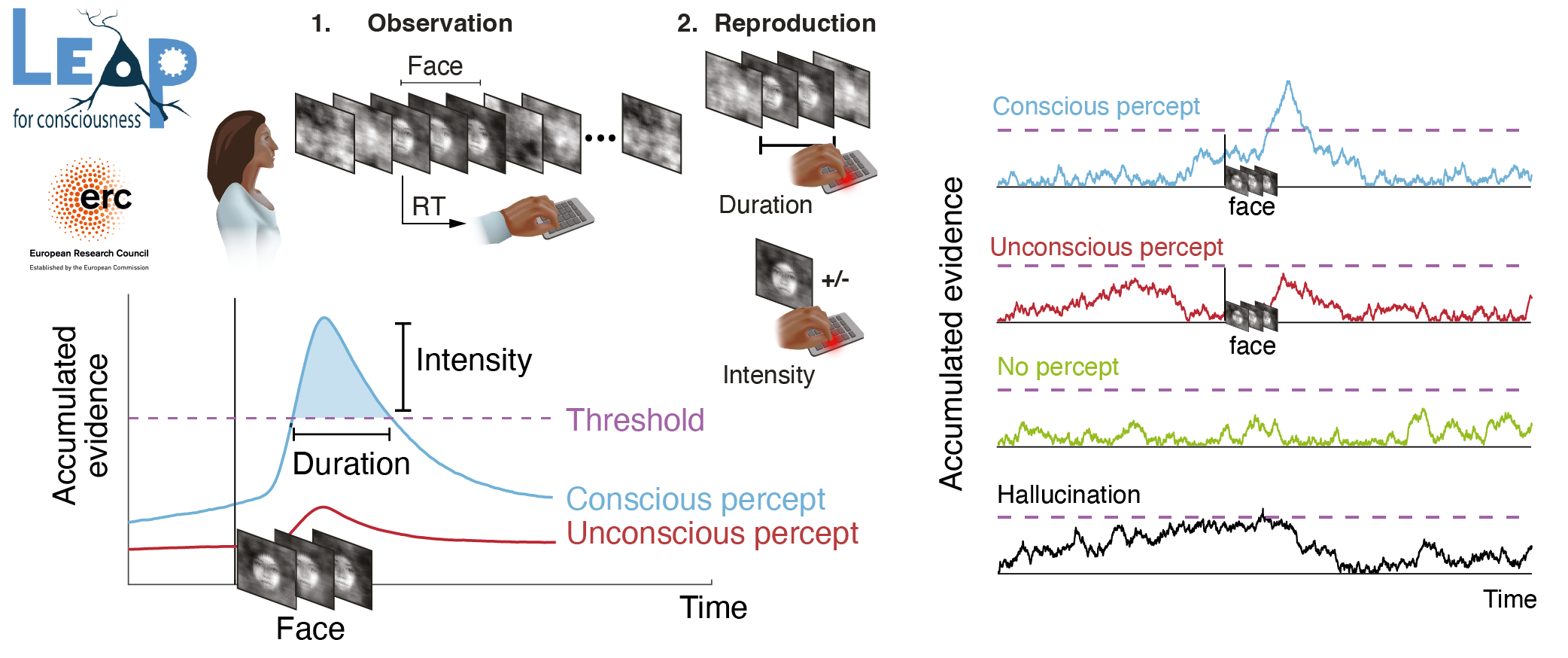
The difficulty is that telling us about an experience also requires deciding and acting, and recordings from the scalp cannot separate these from the experience itself. So we record inside the brain, in people monitored for epilepsy who volunteer for research. With the epileptology unit at Grenoble University Hospital, we record from 10 to 15 participants a year, and we have begun using finer electrodes that can pick up single neurons.
The decisive test is whether the same activity persists when participants simply watch, with nothing to report. So far, it does in the visual cortex, while much of the activity in frontal and parietal regions does not.
We also ask what happens when consciousness fades. In patients who receive anesthesia while their electrodes are in place, we follow how activity in the hearing areas of the brain, and their exchanges with deeper structures, change as patients stop responding.
Hallucinations may be this process tipped too far toward expectation. With the movement disorders unit, we are testing that in Parkinson's disease, where up to a third of patients hallucinate and the symptom is both underdiagnosed and poorly understood. To find the brain network involved, we also map how brain regions influence one another, using the brief electrical pulses that doctors deliver during epilepsy monitoring.
Some of our questions are conceptual. With philosophers at the Institut de Philosophie de Grenoble (LUCID-P project), we ask how precise or indeterminate a perception can be, and how that relates to whether it is conscious.
After a decision, most of us have a sense of how likely we are to be right. This ability is called metacognition, and it is useful precisely because it tracks our actual performance. Obsessive-compulsive disorder (OCD) is sometimes called the doubting disease. Yet whether doubt in OCD is genuinely out of step with performance, rather than simply intense, is still unsettled: published studies disagree.
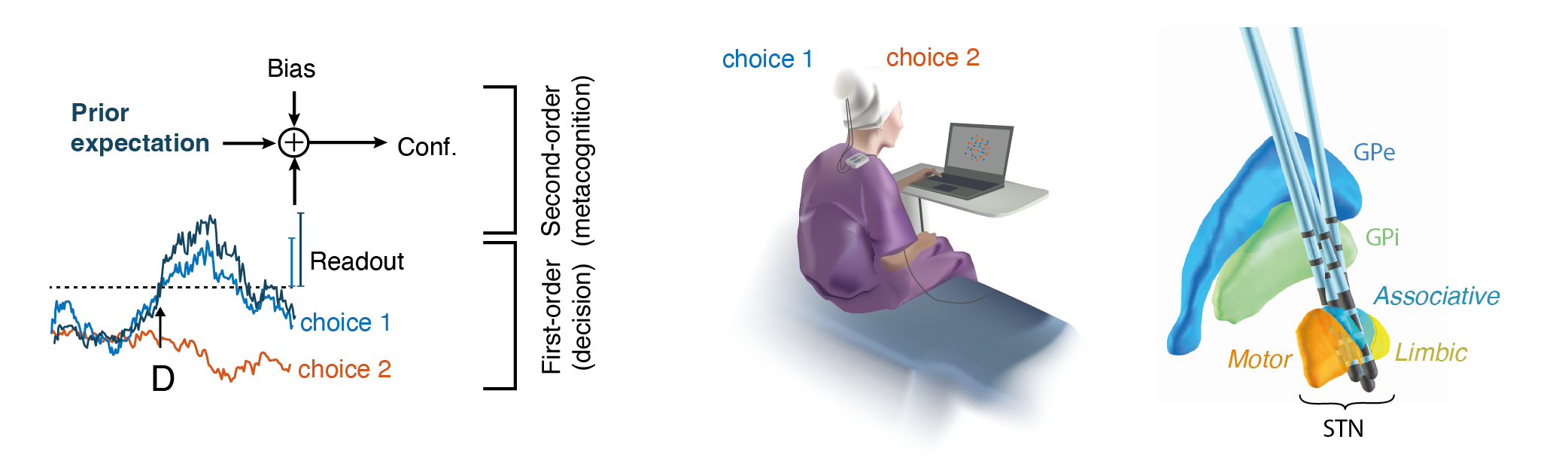
We approach this by making the laboratory task resemble the symptom. Participants make difficult perceptual judgments and may repeat a trial when unsure, which reproduces something close to checking. Fitting computational models to that behavior lets us ask which part of the decision process differs in patients, rather than only whether the groups differ.
We combine three sources of data: brain activity recorded from the scalp (EEG) in patients recruited with the psychiatry department at Grenoble University Hospital; recordings from a deep brain structure, the subthalamic nucleus, in patients treated with deep brain stimulation; and online experiments in large groups of volunteers with varying levels of compulsive traits.
One of our own findings frames the problem: deep brain stimulation can improve symptoms without restoring patients' ability to judge their own decisions. We would like to know why.